Index by category›
Review pending
Body & signals
Learn how molecules, receptors and organs connect. Follow a source for each relationship.
Explore these explanations
Organs & regions
Explore the body
Select a marker or an organ name to explore its role.
Frontal overview: the person’s left is on your right. The stomach is translucent to reveal the pancreas behind it. Shapes and proportions remain simplified; unmarked organs are omitted.
The kidneys lie behind the abdominal organs; their dashed contours are projected onto this front view. Overlap does not represent a single anatomical plane.
Source: OpenStax — anatomyHypothalamus
A brain region that links neural signals to pituitary hormone regulation.
Explore this organSource: NCI / SEER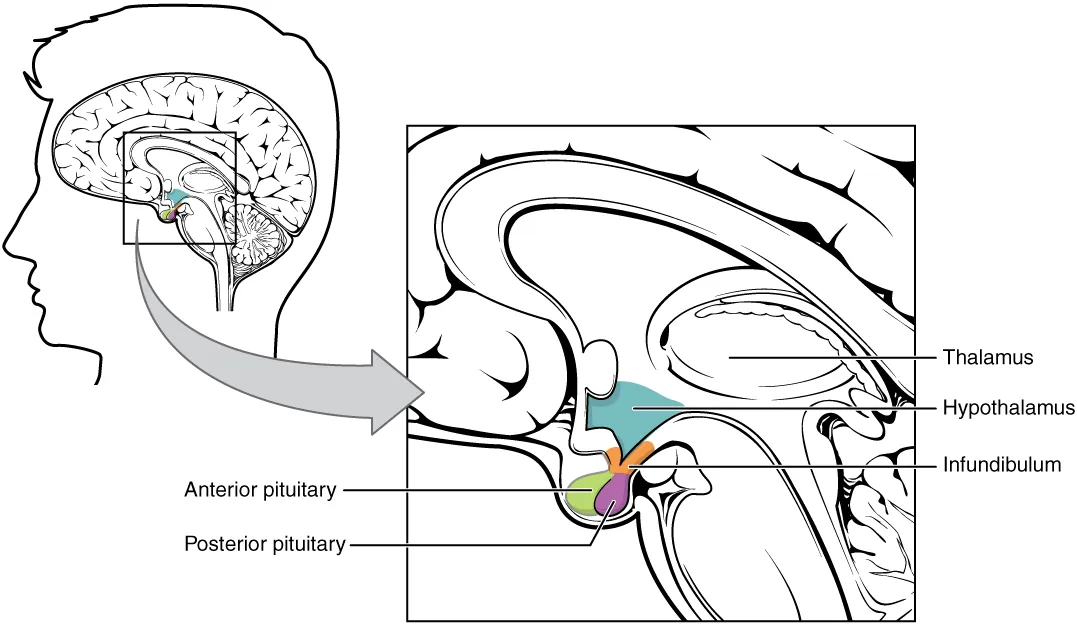
Sagittal view: hypothalamus above the pituitary, connected by the infundibulum. Anterior and posterior pituitary lobes are shown.
OpenStax College — The Hypothalamus-Pituitary Complex · CC BY 3.0 · Original English labels; image converted to WebP. Open the image to enlarge.
Image label key
- Thalamus
- Thalamus
- Hypothalamus
- Hypothalamus
- Anterior pituitary
- Anterior pituitary
- Posterior pituitary
- Posterior pituitary
- Infundibulum
- Infundibulum (pituitary stalk)
Start with the signal
A peptide is a chain of amino acids. Some peptides carry signals. A ligand binds to a receptor; an agonist activates it. Receptors pass information into cells, which can change secretion, metabolism or other activity. The response depends on the cell and context.
Endocrine signals travel through blood to distant cells. Paracrine signals act nearby; autocrine signals act on the releasing cell. Direct cell contact and synaptic communication provide other routes. A molecule can therefore influence an organ indirectly through a second signal.
Source: The Cell — Signaling Molecules and Their ReceptorsRead each link separately: molecule → receptor; receptor → cell signal; signal → organ response. Evidence for one step does not prove the whole chain or a clinical benefit. Organ icons always have a text label explaining the relationship.
Organs & regions
The atlas is being expanded. Missing links indicate gaps in this map, not absence of biology.
A brain region that links neural signals to pituitary hormone regulation.
Pituitary glandAn endocrine gland connected to the hypothalamus. Its anterior lobe secretes growth hormone, among other hormones.
PancreasIts endocrine islets contain cells that release insulin and glucagon, hormones involved in blood glucose regulation.
StomachA digestive organ that also releases hormonal signals, including gastrin. A signal’s site of production is distinct from its target.
Small intestineIts lining releases secretin and cholecystokinin, signals involved in coordinating digestion.
HeartAlongside pumping blood, atrial cells release a natriuretic hormone. Organs can both perform a mechanical task and send chemical signals.
LiverLocated mainly below the diaphragm on the right. The liver produces bile and participates in carbohydrate, fat and protein metabolism.
KidneysTwo organs near the posterior abdominal wall filter blood and remove waste in urine. The right kidney usually lies slightly lower than the left.
Receptors
AMY1 receptor (CALCR/RAMP1 complex)
AMY₂RAMY2 receptor (CALCR/RAMP2 complex)
AMY₃RAMY3 receptor (CALCR/RAMP3 complex)
CTRCalcitonin receptor
GCGRGlucagon receptor
GHS-R1aGrowth hormone secretagogue receptor type 1a
GIPRGastric inhibitory polypeptide receptor
GLP1RGlucagon-like peptide 1 receptor
MC1RMelanocortin 1 receptor
MC3RMelanocortin 3 receptor
MC4RMelanocortin 4 receptor
MC5RMelanocortin 5 receptor
METHepatocyte growth factor receptor
OX1Orexin receptor type 1
OX2Orexin receptor type 2
TrkATrkA neurotrophin receptor
TrkBTrkB neurotrophin receptor